The EU Commission has released draft legislation aimed at tackling the destruction of woodland by introducing import restrictions on products not certified as ‘deforestation-free’.

The draft proposal, which the commission hopes will become binding rules for all member states, seeks to limit the import of beef, cocoa, coffee, palm, soy, and wood if it is not proven “deforestation-free.”

Outlining the legislation, the EU commissioner for climate action policy, Virginijus Sinkevicius, called it a “ground-breaking” proposal that will help fight “illegal deforestation” and “deforestation driven by agricultural expansion.”

The bill comes after nations at the COP26 summit agreed to work to end deforestation by 2030. It would impose two criteria on imports, requiring items to have been produced in accordance with the origin country’s laws, and not on land that has been deforested or degraded since the start of 2021.

It is not clear when the rules would come into effect; legislative proposals by the commission have to be debated and considered by both the EU Parliament and the Council of the EU before they are passed. The implementation of measures could potentially impact the EU’s trade relations with countries like Brazil, where clearing of the Amazon rainforest hit a new record in October.

During the recent COP26 climate summit, 110 world leaders – whose countries contain around 85% of the world’s woodland – committed to ending and reversing deforestation by 2030, pledging around £14 billion ($18.84 billion) of public and private funds towards the goal.

Like this story? Share it with a friend!
find more fun & mates at SoShow now !

Covid-battered global supply chains are being threatened by organized criminals, including drug cartels and con artists posing as legit suppliers, a new study has found, warning that the situation is set to get worse.

The international supply chain woes amid the Covid-19 pandemic are highlighted in a new annual report, released this week by the British Standards Institution (BSI).

The document, titled the ‘Supply Chain Risk Insights Report’, highlights Covid’s impact on supply chains, with the experts also warning that organized crime has increasingly preyed on this crucial area during the pandemic. On multiple instances, criminals were posing as legitimate logistics providers, stealing goods during shipment.

“I’m seeing a significant number of false suppliers acting as genuine potential suppliers in supply chain logistics provision – warehousing distribution, distribution centres, transportation companies – and actually, they are criminal groups trying to infiltrate the logistics supply chain,” said David Fairnie, BSI’s principal consultant in supply chain security. He urged producers to “continuously monitor” the supply chain and to not immediately trust new logistics providers – especially those contacted only remotely.

So, arguably today more than ever, you do need to know your suppliers. So far in 2021, BSI has noted this issue of fake carriers in an increasing number of countries in both the Americas and Europe.

Criminals have apparently been trying to steal goods in various ways, with phony truck drivers loading up items and taking off with them, while conmen “posing as legitimate employees” have reportedly been observed lurking around delivery destinations to steal cargo.

Read more

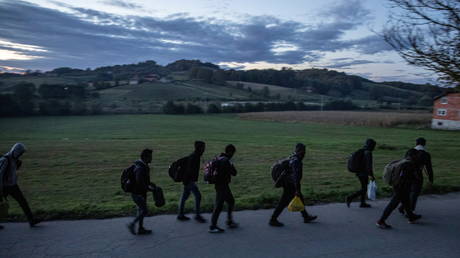
FILE PHOTO: Migrants walk towards the Bosnia-Croatia border in attempt to cross. © Reuters / Marko Djurica
Human trafficker explains migrant smuggling business

At the same time, the report found that trade in illicit goods has also been on the rise lately, with the illegal drug industry in particular appearing to flourish. While the supply chain for drug cartels, which require large amounts of assorted chemicals to produce narcotics, was disrupted due to the pandemic lockdowns and border closures impacted trafficking routes, organized crime quickly overcame these problems, the BSI noted.

“Drug cartels around the world did not miss a beat,” Chris Tomas, BSI lead intelligence analyst, said.

While many cartels shifted their production towards synthetic drugs, namely amphetamine, amid the pandemic, the apparent “lack of eradication of coca crops in Latin American countries” also remains an issue, the BSI said. The flow of cocaine has grown over the past year and is expected to increase even further, the organization warned.

“The numbers and quantities of cocaine seizures in Europe increased steadily in 2020 and 2021 and are expected to continue to rise in 2022,” the report reads.

Think your friends would be interested? Share this story!

find more fun & mates at SoShow now !

Australia’s Jewish community has condemned the repeated displays of Nazi references at anti-vaccine and anti-lockdown rallies in Victoria, some of which saw the state premier depicted as Adolf Hitler.

Daniel Aghion, the president of the Jewish Community Council of Victoria, claims that references to the genocidal regime of the Nazis amid the current unrest over pandemic rules is a false equivalence.

“The Nazis had the intention of wiping from the face of the Earth a race or religion simply because of what they were,” Aghion told Guardian Australia. “Nothing in the current proposals is remotely like that, and the comparison to Nazi Germany is therefore shocking, inappropriate and wrong,” he added.

Aghion’s comments come after demonstrators, protesting against pandemic laws, referenced Nazi Germany in an effort to make their point. Some carried placards depicting state premier, Daniel Andrews, as Hitler. 

 Wendy Lovell, a Liberal MP, had also claimed laws proposed to govern future pandemics were similar to Germany’s 1933 Enabling Act – which allowed the Reich government to issue laws without the consent of parliament and preceded atrocities, most notably the Holocaust.

MP Bernie Finn had gone as far as to share a social media post depicting the state premier as Hitler. It was later deleted.Laws proposed by Andrews seek to grant powers to the state leaders in the event of another pandemic. Under the move, the minister “may make any order… that the minister believes is reasonably necessary to protect public health.” 

Opponents claim the legislation, which would see power concentrated with the head of state and health minister, is too broad and far reaching.

If you like this story, share it with a friend!

find more fun & mates at SoShow now !

A cleaner for Israel’s defense minister has been accused of espionage after allegedly offering to place malware on his boss’ household computer for an Iran-linked hacking group.

In a statement on Thursday, the Shin Bet security service said that Omri Goren, a housekeeper for Defense Minister Benny Gantz, and a former bank robber according to Israeli media, corresponded with an unnamed person over social media shortly before his arrest. 

Read more

American Businessman Bill Gates (FILE PHOTO) © Jeff J Mitchell/Pool via REUTERS
Bill Gates predicts Covid-19 mortality rate

Goren reached out earlier this month to “a figure affiliated with Iran and offered to help him in different ways, in light of his access to the minister’s home,” the statement read, according to the Times of Israel.

It is understood that Goren offered to spy and place malware on Gantz’s computer on behalf of a hacking group, reportedly called ‘Black Shadow’ and associated with Iran, Tel Aviv’s perennial enemy. It is also said that he provided photos of Gantz’s residence to prove he had access. 

A Central District prosecutor filed espionage charges against Goren on Thursday. If convicted, the accused could face a sentence of between 10 and 15 years, according to the Times of Israel.

The 37-year-old Lod resident has previously served four prison sentences, the most recent of which was for four years. Goren was found guilty of five crimes between 2002 to 2013, two of the convictions were for bank robbery.

The Shin Bet said they would review their processes for staff background checks “with the goal of limiting the possibility of cases like this repeating themselves in the future.”

Speaking on Kan public radio, Gal Wolf, the attorney representing Goren, suggested his client had intended to extract money from the Iranians without carrying out any spying.

If you like this story, share it with a friend!

find more fun & mates at SoShow now !

The EU Commission has released draft legislation aimed at tackling the destruction of woodland by introducing import restrictions on products not certified as ‘deforestation-free’.

The draft proposal, which the commission hopes will become binding rules for all member states, seeks to limit the import of beef, cocoa, coffee, palm, soy, and wood if it is not proven “deforestation-free.”

Outlining the legislation, the EU commissioner for climate action policy, Virginijus Sinkevicius, called it a “ground-breaking” proposal that will help fight “illegal deforestation” and “deforestation driven by agricultural expansion.”

The bill comes after nations at the COP26 summit agreed to work to end deforestation by 2030. It would impose two criteria on imports, requiring items to have been produced in accordance with the origin country’s laws, and not on land that has been deforested or degraded since the start of 2021.

It is not clear when the rules would come into effect; legislative proposals by the commission have to be debated and considered by both the EU Parliament and the Council of the EU before they are passed. The implementation of measures could potentially impact the EU’s trade relations with countries like Brazil, where clearing of the Amazon rainforest hit a new record in October.

During the recent COP26 climate summit, 110 world leaders – whose countries contain around 85% of the world’s woodland – committed to ending and reversing deforestation by 2030, pledging around £14 billion ($18.84 billion) of public and private funds towards the goal.

Like this story? Share it with a friend!
find more fun & mates at SoShow now !

The EU Commission has released draft legislation aimed at tackling the destruction of woodland by introducing import restrictions on products not certified as ‘deforestation-free’.

The draft proposal, which the commission hopes will become binding rules for all member states, seeks to limit the import of beef, cocoa, coffee, palm, soy, and wood if it is not proven “deforestation-free.”

Outlining the legislation, the EU commissioner for climate action policy, Virginijus Sinkevicius, called it a “ground-breaking” proposal that will help fight “illegal deforestation” and “deforestation driven by agricultural expansion.”

The bill comes after nations at the COP26 summit agreed to work to end deforestation by 2030. It would impose two criteria on imports, requiring items to have been produced in accordance with the origin country’s laws, and not on land that has been deforested or degraded since the start of 2021.

It is not clear when the rules would come into effect; legislative proposals by the commission have to be debated and considered by both the EU Parliament and the Council of the EU before they are passed. The implementation of measures could potentially impact the EU’s trade relations with countries like Brazil, where clearing of the Amazon rainforest hit a new record in October.

During the recent COP26 climate summit, 110 world leaders – whose countries contain around 85% of the world’s woodland – committed to ending and reversing deforestation by 2030, pledging around £14 billion ($18.84 billion) of public and private funds towards the goal.

Like this story? Share it with a friend!

find more fun & mates at SoShow now !

Greece will soon prohibit unvaccinated residents from entering a litany of public spaces, the country’s prime minister has announced, claiming its current Covid outbreak is largely fueled by those who haven’t received the jab.

Starting next week, the unvaccinated will be barred from entry to restaurants, cafes, theaters, bars, gyms and museums, among other indoor public places, PM Kyriakos Mitsotakis said on Thursday, noting that a negative Covid-19 test will no longer be accepted as an alternative to proof of vaccination.

“This is indeed a pandemic of the unvaccinated,” he said as he announced the move in a televised address, adding “Greece is mourning unnecessary losses because it simply does not have the vaccination rates of other European countries.”

The new rules are set to take effect on Monday, and will require Greeks to present vaccine certificates to businesses and other indoor establishments to be allowed inside. Those attending religious services mark a rare exception, however, as they will only be asked to present a negative test in order to enter a church or other place of worship.

Read more

People wait in front of a vaccination after Austria's government has imposed a lockdown on people who are not fully vaccinated, in Vienna, Austria, November 18, 2021. © Reuters /Leonhard Foeger
Austria may lock down the vaccinated too

In a bid to encourage booster vaccinations among the elderly – a population much more vulnerable to Covid-19 – citizens over the age of 60 will be made to renew their certificate after a period of seven months.

While officials had hoped to hit a full vaccination figure of 70% for Greece’s population of 11 million by autumn, the number currently stands at about 62%, according to Reuters. As its weekly case counts continue to soar to record highs, the country reported 7,317 new Covid-19 infections and 63 deaths on Thursday, bringing the totals to more than 860,000 cases and some 17,000 fatalities since the pandemic kicked off in late 2019.

The new restrictions in Greece mirror similar policies implemented elsewhere in Europe, with Austria, Germany, Italy, France, the Czech Republic and Slovakia each imposing limits on public life for the unvaccinated. Though the Austrian government recently imposed a full lockdown for millions of residents who have not received the shot, some officials in that country are pushing for even harsher policies, including a national stay-at-home order on the jabbed and non-jabbed alike.

Think your friends would be interested? Share this story!

find more fun & mates at SoShow now !

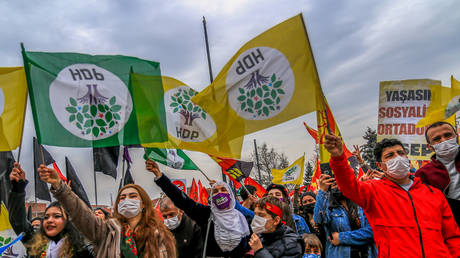
Syrian-born musician Omar Souleyman, who worked with the likes of Bjork and Damon Albarn, has been detained in Turkey over alleged links to the Kurdistan Workers’ Party, which is deemed a terrorist group by Ankara.

Souleyman was brought in for questioning on Wednesday, with officers also searching through his home in Turkey’s southeastern province of Sanliurfa, the singer’s manager said.

Read more

Pro-Kurdish Peoples' Democratic Party (HDP) supporters shout slogans and hold flags during a rally as part of Nowruz (Newroz). © Tunahan Turhan/SOPA Images/LightRocket via Getty Images
Turkey’s top court accepts indictment to dissolve pro-Kurdish HDP party

The arrest was likely provoked by recent reports that the musician had traveled to an area in Syria controlled by the Kurdish militias known as the YPG, he added.

The YPG have been US allies in the fight against Islamic State (IS, formerly ISIS), but Turkey considers them to be an extension of the Kurdistan Workers’ Party (PKK) and a threat to its national security.

For decades, the Workers’ Party has been fighting Turkish troops in the southeast of the country, striving for greater autonomy for the Kurdish population.  

Souleyman’s son denied his father’s alleged terrorist links, saying he didn’t have any political affiliation and had become the victim of a “malicious report.” Some media outlets claimed the musician could be released from custody later on Thursday.

Coming from Syria’s majority-Kurdish province of Hasekeh, Souleyman had been known as a prolific wedding performer in his home country. But his international career skyrocketed after he moved to Turkey a decade ago, fleeing the Syrian conflict. The 55-year-old’s clips, including his top hit ‘Warni Warni’, have garnered millions of views on YouTube. He performed at the Nobel Peace Prize ceremony in 2013, as well as at many large festivals around the globe.

His unique style, which is based on mixing traditional Middle Eastern folk music with electronic sound, has attracted the attention of such stars as Bjork, Four Tet, Damon Albarn, and Diplo, who have all collaborated with Souleyman.

Like this story? Share it with a friend!
find more fun & mates at SoShow now !

The European Union’s top court has ruled that Hungary’s 2018 law aimed at criminalizing aiding illegal immigrants who are claiming asylum violates the “rights safeguarded” by the bloc’s legislature.

The Hungarian legislation, passed in 2018, sought to punish anyone “facilitating illegal immigration” with a year in prison, under a bill dubbed the “Stop Soros” law. Hungary’s government justified it at the time by arguing that migrants illegally entering the country threatened its national security. 

In the ruling, handed down on Tuesday, the European Court of Justice declared that “criminalizing such activities impinges on the exercise of the rights safeguarded by the EU legislature in respect of the assistance of applicants for international protection.”

The EU’s advocate general, Athanasios Rantos, had urged the court to make such a judgement back in February, claiming the introduction of the legislation meant that “Hungary has failed to fulfil its obligations under the [bloc’s] Procedures Directive.”

It became known as the Stop Soros law after billionaire philanthropist George Soros became a vocal opponent of the Hungarian government’s opposition to migration. The administration, in turn, accused Soros of orchestrating migration to Europe, with the Open Society Foundation, run by the philanthropist, closing its operation in the country in response. 

Read more

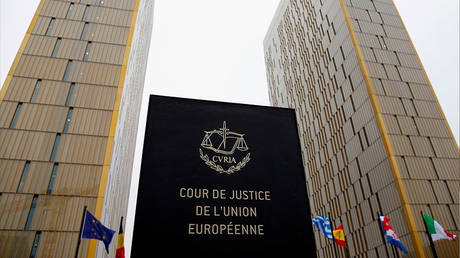
The towers of the European Court of Justice are seen in Luxembourg. © Reuters / Francois Lenoir
Top EU court says Poland broke rules with judge appointment system

Hungary, under the leadership of right-wing Prime Minister Viktor Orban, has repeatedly clashed with the EU in recent years over its strong stance on immigration and concerns from the bloc about threats to the rule of law in the country.

At the end of 2020, a dispute between Hungary and Poland and the EU risked derailing the bloc’s budget, as both member states were threatening to veto it over their view that the EU was attempting to interfere in their domestic affairs. Ultimately, the EU backed down, agreeing to a compromise with Budapest and Warsaw to ensure the budget secured the support of all 27 member states. 

Despite acknowledging the EU court’s ruling, Hungary’s government defended its right to challenge any foreign-funded non-government organizations that are attempting to “promote migration.”

“Hungary’s position on migration remains unchanged: Help should be taken where the problem is, instead of bringing the problem here,” Hungarian government spokesperson Zoltan Kovacs said, adding that the country will challenge outside entities “seeking to gain political influence and interference.”

Think your friends would be interested? Share this story!

find more fun & mates at SoShow now !

An Argentinian woman has become the second-ever HIV-infected person whose immune system helped defeat the virus without requiring additional medical treatment. She was first diagnosed with the AIDS-causing infection in 2013.

Scientists have dubbed the 30-year-old mother the “Esperanza patient,” after her hometown. The word ‘esperanza’ translates to ‘hope’ in English. Publishing their findings in the Annals of Internal Medicine journal on Monday, the researchers said the discovery boosts hope for a “sterilizing cure” for the estimated 38 million people with the life-long infection.

“I enjoy being healthy,” the Esperanza patient told NBC News over email. “I have a healthy family. I don’t have to medicate, and I live as though nothing has happened. This already is a privilege.”

The study found no intact remnants of the virus in the 1.5 billion blood and tissue cells the researchers analyzed – confirming the discovery first announced in March at an international meeting of HIV experts.

Read more

© Belova59 from Pixabay
‘Elite controllers’ can cure themselves of HIV without any medical treatment, bombshell research claims

No additional information about the woman has been made public, but she was described at the time as “athletic and beautiful” and revealed to have an HIV-negative boyfriend and newborn baby.

Only one other person, identified in August 2020 as 67-year-old Loreen Willenberg from San Francisco, has been confirmed to have overcome the virus without medical intervention. The two women have been labeled ‘elite controllers’, referring to a rare subset of HIV patients who show no signs of the infection despite not undergoing antiretroviral treatments.

Typically, an HIV-infected person requires constant drug therapy to prevent the virus from attaching to their immune cells’ DNA and replicating. But, in the eight years since she was diagnosed, the Esperanza patient only received medication for six months during pregnancy to ensure her baby would be healthy.

In all, there have been four patients cured of HIV, two of whom – the ‘Berlin patient’ Timothy Ray Brown and the ‘London patient’ Adam Castillejo – were also cancer patients who received risky bone marrow transplants from donors with HIV-resistant genes. However, the success of their procedures is yet to be replicated.

“This is really the miracle of the human immune system that did it,” Dr. Xu Yu, an immunologist at the Ragon Institute in Boston, who co-authored the study, told NBC.

If you like this story, share it with a friend!

find more fun & mates at SoShow now !